


A CP2501 notice means the IRS found income you didn’t report on your tax return. The income is already in the IRS system through 1099s, W-2s, or other employer or financial institution-issued forms. You have 30 days to respond.
This is not an audit. It’s called a “pre-assessment notice” or “initial inquiry letter.” The IRS is asking you to either confirm that the information is wrong or explain why you didn’t report it.
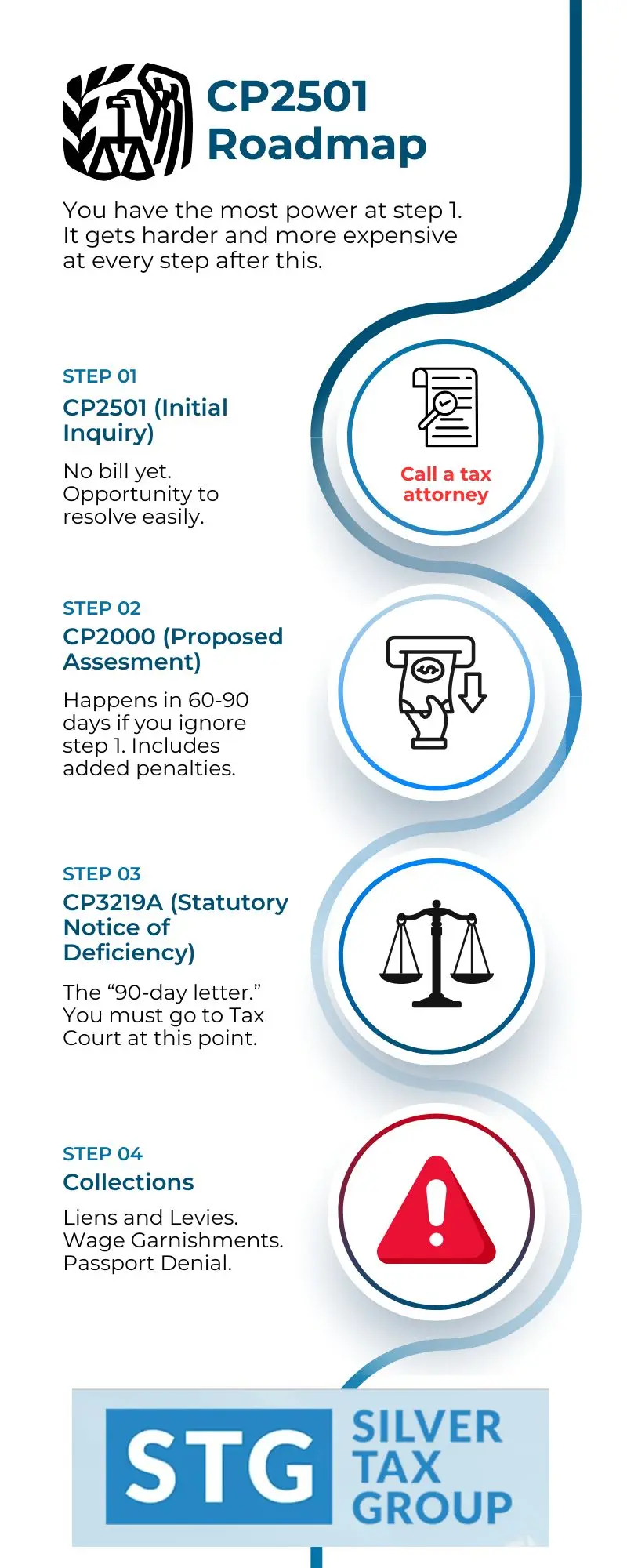
If you don’t respond, they’ll send a CP2000 notice with a proposed tax bill.

How CP2501 Differs from CP2000
CP2501 comes first. It doesn’t include a calculated amount owed. It’s asking you to verify your records before the IRS takes formal action.
An IRS CP2000 notice is what comes next if you ignore CP2501. It includes specific numbers for taxes, penalties, and interest you supposedly owe.
CP3219A is a notice of deficiency, the final notice before the IRS sends a formal bill. You have 90 days to file a Tax Court petition if you disagree.
Why You Received a CP2501 Notice
The IRS matches information from third parties against your return. When amounts don’t match, you get a CP2501. Common reasons include:
- Third-party income was higher than what you reported.
- An employer reported $45,000 in wages but you put $40,000 on your return.
- A bank reported $2,300 in interest income you didn’t include.
- A business paid you 1099 income you forgot to report.
- You claimed a credit (like education or child tax credit) but didn’t provide the required form.
- Income shows on a corrected 1099 that was issued after you filed.
What to Do When You Receive CP2501 (5 Steps)
Step 1: Read the notice completely. The IRS explains what income they have on file and why there’s a mismatch. They include the issuer’s name and the amount reported.
Step 2: Get your copies of all income documents. Find your W-2s, 1099s, 1098s, and any other forms from the year in question.
Step 3: Compare these documents line by line with your tax return.
Step 4: Gather any documentation that supports your position. If you didn’t report income because you didn’t receive the form, find bank statements showing the transactions. If you received a corrected form after filing, keep that document. If you have documentation that the income belongs to someone else (identity theft case), collect those records.
Step 5: Decide whether you agree or disagree with the IRS.
Quick Guide on How to Respond to IRS Notice CP2501
| If Your Situation Is... | Action Required | Documents to Include |
|---|---|---|
| You Agree The IRS information is correct. | Sign and return the response form. Pay any tax owed by the deadline to avoid further interest. |
|
| You Disagree The IRS information is wrong. | Write a signed statement explaining the specific reasons you disagree. Mail/fax it with the response form. |
|
| Identity Theft Income reported belongs to someone else. | Call the financial institution listed to verify. File an Identity Theft Affidavit with your response. |
|
| You Need More Time 30 days isn't enough. | Submit a written extension request to the address on the notice before the 30 days are up. |
|
| You Don't Respond WARNING | The IRS will escalate to Notice CP2000. |
|
If You Agree with the CP2501
Sign and return the response form included with the notice. Both spouses must sign if you filed a joint return. Mail or fax it to the address provided on the notice. Pay any taxes owed by the deadline shown to avoid additional interest and penalties.
The IRS will process the adjustment and send you a notice explaining the changes they made to your account.
If You Disagree with the CP2501
Write a signed statement explaining why you disagree. Include specific reasons and supporting documentation. Mail or fax both the response form and your statement to the address on the notice.
Possible explanations include:
- The income was reported in error and doesn’t belong to you.
- You already reported the income (the form duplicates what’s on your return).
- The income is from a prior year.
- You received a corrected form after you filed that shows a lower amount.
- The income is from identity theft.
If You Partially Agree
You can sign the response form and include a statement about the specific items you disagree with. Return both documents with supporting evidence.
Use This "Copy-Paste" CP2501 Response Letter Template:
Subject: Response to Notice CP2501 – [Your Name] – [Social Security Number]
To the Internal Revenue Service:
I am writing in response to the CP2501 notice dated [Date on Notice] regarding tax year [Year].
I respectfully disagree with the proposed changes for the following reason(s):
[Reason 1]: Example: The income reported by [Bank Name] in the amount of $500 is actually a non-taxable reimbursement, not income. Please see the attached bank statement highlighting this deposit.
[Reason 2]: Example: The W-2 income from [Employer Name] was already reported on my return, but it was listed under “Other Income” on Line 8 instead of Line 1. Please see the attached copy of my 1040.
Enclosed you will find:
A copy of the CP2501 response page (signed).
Copies of the supporting documents mentioned above.
Please update my account records to reflect this information.
Sincerely,
[Your Signature] [Your Phone Number]
How to Mail in Your Response
-
Never use regular mail: Always use USPS Certified Mail with Return Receipt. This provides a green card (physical or electronic) proving someone at the IRS stamped and received your package.
-
Don’t send originals: Explicitly remind them to send copies of W-2s or bank statements. If the IRS loses the originals, the taxpayer is in trouble.
-
Faxing is faster: Mention that if a fax number is provided on the CP2501, faxing is acceptable and creates an instant transmission record.
The 30-Day Deadline Matters
The CP2501 shows a response deadline. Missing this deadline has real consequences. The IRS will proceed with a CP2000 notice that includes a proposed tax bill. You’ll lose negotiating power at that stage. Penalties and interest will continue to accumulate.
Request an extension if you need more time. Include your extension request with any response documents you’re sending.
What Happens If You Don't Respond
The IRS sends a CP2000 notice within 60-90 days. This notice includes a specific dollar amount for additional taxes owed, plus penalties and interest. You’ll now face a 20% accuracy-related penalty on the additional tax (40% in some cases, up to 75% if fraud is suspected). Interest compounds daily from the original return due date. Each day increases the amount you owe.
If you ignore CP2000, the IRS can take collection actions. They can issue a Notice of Federal Tax Lien. They can garnish your wages or levy your bank account. Your passport can be flagged if the debt exceeds $50,000. You may lose eligibility for payment plans or offer in compromise options. Future tax refunds will be offset to pay the debt.
Special Situation: Identity Theft
If someone used your Social Security number to obtain income, the CP2501 may show income that isn’t yours. Call the employer or financial institution listed on the notice to verify. If it’s identity theft, file Form 14039 (Identity Theft Affidavit) with the IRS along with your CP2501 response.
Special Situation: Extension Requests
If 30 days isn’t enough time to gather documentation or prepare a response, you can request an extension. Submit a written request to the IRS office shown on your notice before the 30-day deadline expires. Explain your situation: you might need time to collect documents, coordinate with a tax professional, or address other circumstances.
The IRS won’t approve every extension request, but they do approve them when you have a real reason. Don’t wait until day 29 to ask. Submit your request early so there’s time for the IRS to process it and send you a new deadline in writing.
Expert Tip: The Penalty Abatement Secret
Even if you do owe the money and made a mistake, you might not have to pay the penalty. If you have a clean tax history for the past three years, you can request ‘First-Time Abatement‘ for failure-to-pay penalties. You usually have to request this after the tax is assessed, but knowing it is an option reduces anxiety now. This is something we can help with.
How We Handle CP2501 Notices at Silver Tax Group
We gather your documents and compare them against the IRS notice. We identify which items are correct, which need explanation, and which can be disputed. We prepare your response with supporting documentation. We handle communication with the IRS directly so you don’t have to navigate phone holds and recorded lines. We meet the 30-day deadline to protect your options.
If the IRS sends a CP2000 after your response, we continue representation through that process. Our tax attorneys and CPAs work with clients across the U.S. who have received CP2501 notices. We know which explanations the IRS accepts and which ones require additional documentation.
Contact Silver Tax Group
If you received a CP2501 notice, call us. We’ll review your notice and explain what you’re facing. We’ll tell you whether we can resolve this quickly or if you need ongoing representation. We handle the 30-day response window so you don’t miss the deadline.
Don’t ignore the notice hoping it goes away. The IRS will escalate your case. We can stop that process with a timely, documented response.


