

If you’ve looked into the IRS Offer in Compromise program, you’ve likely hit a wall the moment the term “reasonable collection potential” appeared. Most explanations either bury you in IRS jargon or skip over the mechanics entirely. That’s a problem – because your reasonable collection potential, or RCP, is the number the IRS uses to decide whether your offer is worth accepting at all. Get it wrong, and your OIC gets rejected before a reviewer ever gives it a real look.
I’ve spent years working through these calculations with taxpayers who were convinced they couldn’t qualify, only to find that their RCP had been badly overstated – sometimes by tens of thousands of dollars. The formula isn’t complicated once you break it down. What trips people up is knowing which assets count, how future income gets projected, and where the legal room to reduce that number actually exists.
This article explains how the IRS calculates your RCP, what it means for your minimum offer amount, and why the strategies attorneys use to legitimately lower that number almost never show up in self-filed applications.
What Is Reasonable Collection Potential?
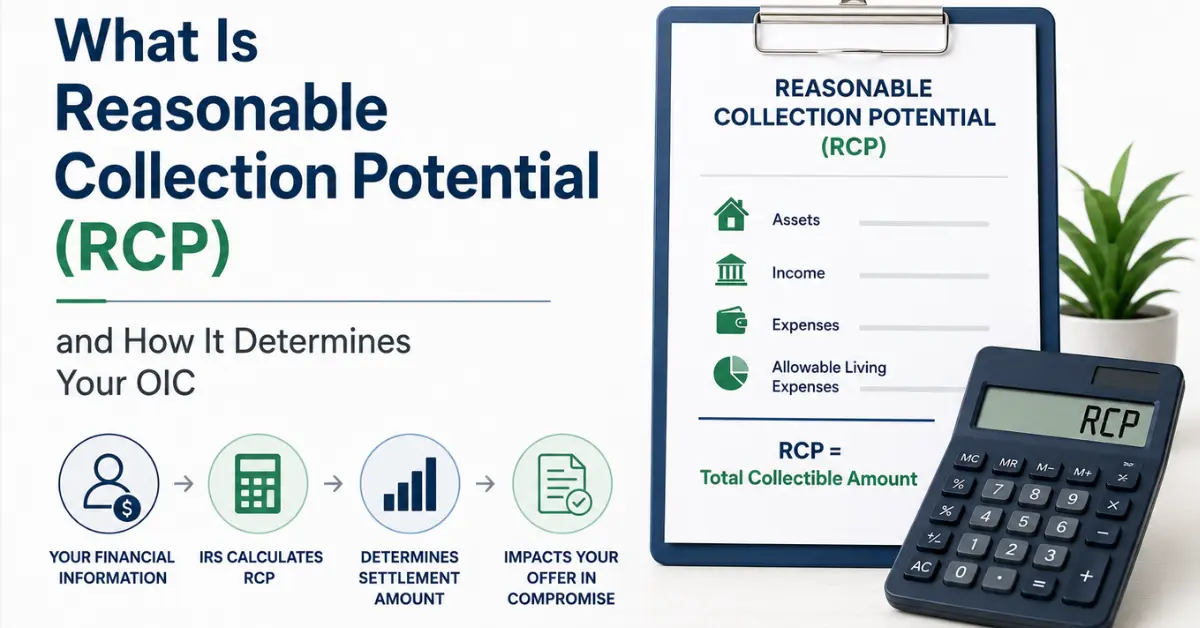
Reasonable collection potential is the IRS’s estimate of how much money it believes it can realistically collect from you – either as a lump sum or through future payments – before the collection statute expires. Your offer must equal or exceed your RCP for the IRS to accept it. If your offer falls short, it gets rejected on the numbers alone.
The formula works like this:
RCP = Net Realizable Value of Assets + Future Income Potential
Both sides of that equation have their own rules, their own pitfalls, and their own reduction strategies. The IRS computes these figures using the financial disclosures you provide on Form 433-A (for individuals) or Form 433-B (for businesses). This is where most self-filed offers go wrong – not because applicants are dishonest, but because they don’t know how the IRS interprets the numbers they report.
How the IRS Calculates Net Realizable Value of Assets
The asset side of RCP starts with what the IRS calls “net realizable equity” – the value of your assets minus what you owe on them, adjusted by a standard discount. The IRS doesn’t value your assets at what you paid for them or what you think they’re worth. It values them at what they could realistically bring at a quick sale.
For most asset types, the IRS applies an 80% quick-sale discount to the fair market value, then subtracts any secured debt. So a house worth $400,000 with a $350,000 mortgage wouldn’t show $50,000 in equity – it would show ($400,000 × 80%) – $350,000 = -$30,000. In this case, the house contributes nothing to your RCP.
The assets the IRS includes in this calculation – and this is where applicants routinely get surprised – go well beyond cash and real estate.
Assets the IRS Counts That Many Applicants Miss
- Retirement accounts (IRAs, 401(k)s, pensions): The IRS counts the current balance of retirement accounts, minus early withdrawal penalties and taxes, as available equity. Many people assume retirement savings are protected. They’re not – the IRS includes them in the calculation, though an experienced attorney can sometimes argue hardship exceptions.
- Business equity: If you own a business, the IRS assigns value to that business using its own formula – typically based on business assets, accounts receivable, and cash on hand. This catches sole proprietors off guard because they often think of the business as separate from their personal tax situation.
- Real estate beyond your primary home: Investment properties, rental properties, and land holdings are all included. Each gets the same 80% quick-sale calculation applied to the equity position.
- Vehicles with equity: If your vehicle is worth more than you owe on it, that equity counts. The IRS does allow an exemption for one vehicle used for necessary transportation, but the exemption amount is capped.
- Life insurance cash value: Whole life policies with accumulated cash value get included. Term policies do not.
- Stocks, bonds, and investment accounts: These count at their current market value, minus any early liquidation penalties where applicable.
How the IRS Projects Future Income
The income side of the RCP calculation is where the math gets more involved – and where the difference between a 12-month and a 24-month collection period can cost you significantly.
The IRS looks at your monthly disposable income: what comes in, minus allowable living expenses. The IRS doesn’t accept every expense you claim. It uses a system of “Collection Financial Standards” – standardized expense allowances for food, clothing, housing, transportation, and healthcare based on your location and household size. If your actual expenses are lower than the standard, the IRS uses your actual expenses. If they’re higher, it generally caps you at the standard amount.
Once the IRS has your monthly disposable income figure, it multiplies that number by a collection period:
- 12 months if you’re paying in a lump sum (within 5 months of acceptance)
- 24 months if you’re paying in periodic payments (within 6 to 24 months)
So if your monthly disposable income is $1,200, your income component of RCP would be either $14,400 (lump sum) or $28,800 (periodic payments). That difference alone can determine whether an offer is feasible for a given taxpayer – which is why payment structure is a strategic decision, not just a logistical one.
What Counts as Allowable Income Deductions
The IRS allows specific monthly deductions when calculating disposable income. Understanding these matters because every dollar of expense you legitimately document reduces your income contribution to RCP. Allowable monthly deductions include:
- National Collection Financial Standards for food, clothing, housekeeping, personal care, and miscellaneous
- Local standards for housing and utilities (based on county)
- Transportation ownership and operating costs (up to standard amounts)
- Out-of-pocket healthcare costs
- Court-ordered payments (child support, alimony)
- Current year federal, state, and local tax obligations
- Life insurance (up to allowed amounts)
- Secured debt payments where there’s legitimate equity in the asset
What’s not deductible: credit card payments, unsecured debt, and voluntary retirement contributions. The IRS takes the position that if you can afford those, you can afford to pay your tax debt.
Strategies Attorneys Use to Legitimately Lower RCP
The IRS allows room to reduce RCP through legitimate means. This isn’t about hiding assets or misrepresenting income – it’s about applying the rules correctly, documenting everything properly, and making strategic arguments the IRS recognizes.
Here’s where professional representation makes a measurable difference.
Correct Asset Valuation
The IRS expects quick-sale value, which is a discount from fair market value. But many self-filers either use the full market value or accept whatever the IRS calculates without challenge. A proper appraisal or documented market comparison can reduce the asset figure meaningfully. This matters most with real estate, business interests, and collectibles – assets where valuation has real range.
Documenting Secured Debt Accurately
Every dollar of secured debt reduces the net equity the IRS can count. Self-filers frequently underreport their secured debt positions – not intentionally, but because they’re not sure what qualifies. Properly documenting mortgages, vehicle loans, business liens, and other secured obligations lowers the asset component of RCP.
Maximizing Allowable Expense Deductions
The IRS National and Local Standards represent the minimum allowed – not the maximum. When actual expenses exceed the standards, you can sometimes document an exception. Medical conditions that drive higher healthcare costs, for instance, are a recognized basis for above-standard expenses. The key is proper documentation, not just a number on a form.
Selecting the Right Payment Structure
As noted above, lump-sum payment uses a 12-month multiplier versus 24 months for periodic payments. For taxpayers with low asset equity but meaningful monthly income, choosing the lump-sum structure can substantially lower the minimum offer amount. This requires having access to funds – often from a third-party loan, family contribution, or retirement distribution – but the math often justifies it.
Arguing Doubt as to Collectibility
An OIC based on doubt as to collectibility is accepted when the IRS agrees that the taxpayer cannot fully pay the liability within the collection period. When an attorney can document that the full liability genuinely exceeds what the IRS could collect – accounting for economic reality, not just the worksheet – the floor for an acceptable offer is the legitimate RCP number, not the tax debt itself.
Why Self-Filed OICs Almost Always Overstate RCP
The IRS rejects a significant percentage of Offer in Compromise applications. For self-filers, that rate is substantially higher – not because those taxpayers don’t qualify, but because the way they report their financial information produces an artificially high RCP figure.
Several patterns show up repeatedly in self-filed applications:
- Using full market value instead of quick-sale value: The 80% discount on assets is IRS policy, but it’s not intuitive. Applicants who pull a Zillow estimate for their house and use that number directly overstate their equity by 20% before accounting for secured debt.
- Missing expense deductions: The IRS Collection Financial Standards are not well-publicized. Self-filers often underreport allowable expenses simply because they don’t know what qualifies, which inflates their monthly disposable income and therefore their RCP.
- Incomplete secured debt documentation: Applicants sometimes leave off vehicle loans, business debts, or second mortgages – reducing the offset that would otherwise lower their net equity figure.
- Including retirement assets at gross value: The correct figure for retirement accounts is net of early withdrawal penalties and the estimated tax hit. Using the gross balance overstates that asset’s contribution to RCP.
- Choosing periodic payment without running the comparison: Because periodic payment uses a 24-month multiplier, it produces a higher minimum offer than lump sum in most cases. Self-filers often default to the periodic structure without understanding the cost of that choice.
The result is an offer that’s higher than it needs to be – or one that looks thin to the IRS because the underlying numbers weren’t calculated correctly, triggering additional scrutiny or outright rejection.
If you’ve already had an OIC rejected by the IRS, the issue is often a correctable calculation problem rather than genuine ineligibility.
Frequently Asked Questions
What is the minimum offer amount for an Offer in Compromise?
Your minimum offer must equal your reasonable collection potential – the sum of your net asset equity and your future income potential. There’s no fixed minimum dollar amount. The IRS uses the RCP calculation to determine the lowest offer it will consider acceptable. Use the IRS Offer in Compromise calculator to get an initial estimate, but recognize that a professional calculation will almost always produce a more favorable number.
Does the IRS include retirement accounts in RCP?
Yes. The IRS treats retirement accounts – including IRAs, 401(k)s, and pension funds – as available assets for RCP purposes. The amount counted is the current balance minus early withdrawal penalties and estimated income taxes. In hardship cases, there may be grounds to argue that accessing retirement funds would create undue hardship, but this requires documentation and legal support to argue successfully.
How does the 12-month vs. 24-month collection period affect my offer?
The collection period multiplier directly affects the income component of your RCP. A lump-sum offer (paid within 5 months of acceptance) uses a 12-month multiplier. A periodic payment offer (paid over 6-24 months) uses a 24-month multiplier. If your monthly disposable income is $1,500, your income component would be $18,000 for a lump-sum offer versus $36,000 for periodic payments – a $18,000 difference in your minimum offer amount from this factor alone.
Can I lower my RCP after submitting an OIC?
Once submitted, your OIC is evaluated based on the financial information you provided. You can submit additional documentation during the review period to correct or clarify figures, and the IRS reviewer may ask for supporting documentation. If your offer is rejected, you have the right to appeal, at which point corrected calculations can be presented. This is why working through the numbers carefully before submission matters – it’s far easier to get the RCP right upfront than to argue corrections afterward.
What expenses does the IRS allow when calculating RCP?
The IRS uses National Collection Financial Standards for basic living costs (food, clothing, personal care) and Local Collection Financial Standards for housing and transportation. These are set figures based on household size and location. Above-standard expenses may be allowed with documentation, particularly for medical conditions. Court-ordered payments, current tax obligations, and secured debt payments are also deductible. Credit card payments and unsecured debts are not.
Why do most self-filed OICs get rejected?
Self-filed applications are rejected at high rates for several reasons: applicants use full market value instead of quick-sale value for assets, miss allowable expense deductions they didn’t know existed, include retirement accounts at gross rather than net value, and choose the periodic payment structure without comparing it to the lump-sum alternative. Each of these errors inflates the reported RCP, producing an offer that’s either too high to make sense for the taxpayer or structured in a way that raises IRS scrutiny.
Is RCP the same as what I owe the IRS?
No. Your RCP is separate from your total tax debt. If you owe $200,000 but your RCP is calculated at $45,000, an offer of $45,000 may be acceptable to the IRS – even though it’s far less than the total liability. This is the core premise of the Offer in Compromise program: the IRS accepts less than what’s owed when it determines that the RCP makes full collection unrealistic.
How long does the IRS take to evaluate an OIC based on RCP?
Most OIC cases take 12 to 24 months from submission to a final decision. During that time, collection activity is paused. If the IRS requests additional financial documentation – which is common when the numbers need verification – response time affects the overall timeline. Cases with well-organized documentation and accurately computed RCP figures tend to move faster than applications that generate back-and-forth over the underlying calculations.
Get Your RCP Calculated Correctly Before You File
Reasonable collection potential determines whether your Offer in Compromise gets accepted or rejected – and the margin between an accurate RCP and an overstated one is often the difference between a viable offer and a wasted filing fee.
The mechanics of the calculation are learnable. The strategies for reducing your RCP legitimately are well-established in tax law. What’s hard to replicate without experience is knowing exactly where the IRS pushes back, which arguments hold up under scrutiny, and how to document an offer that survives review.
If you’re considering an OIC or have already had one rejected, contact Silver Tax Group for a case evaluation. We’ve helped taxpayers significantly reduce their minimum offer amounts by applying the RCP rules correctly from the start – and we can walk through the numbers with you before you commit to anything.