
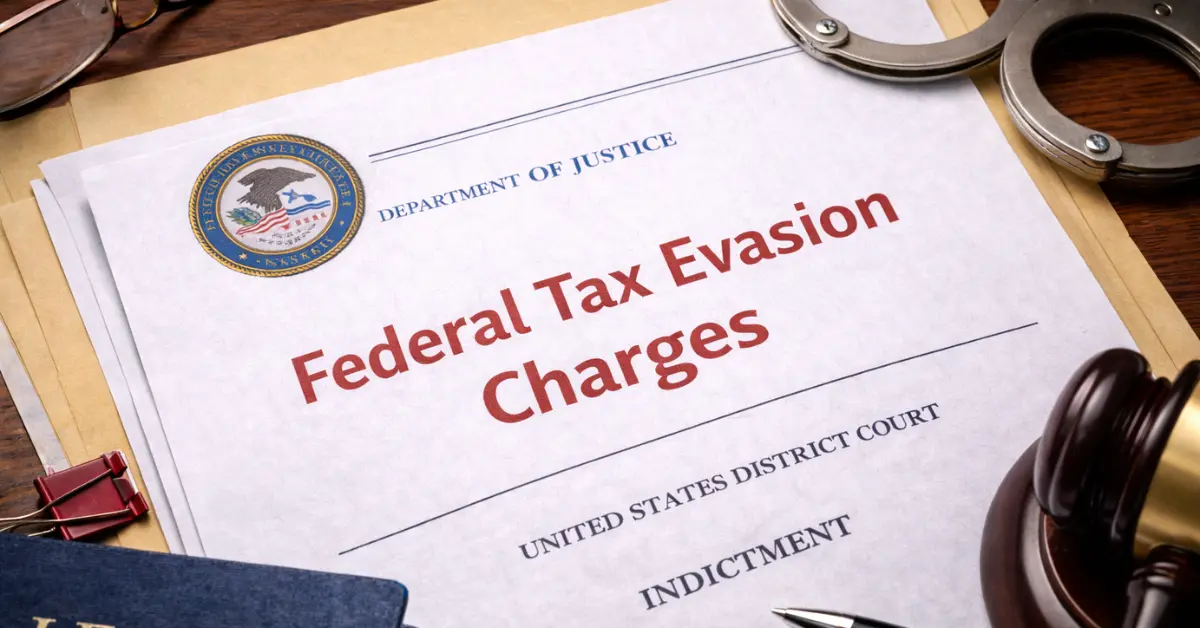
Federal tax evasion charges under 26 U.S.C. § 7201 represent the most serious outcome in any IRS dispute. Not a penalty. Not an audit. A federal felony prosecution that carries up to five years in prison, fines up to $250,000, and mandatory restitution of every dollar the government claims you owed. When IRS Criminal Investigation opens a case and the Department of Justice reviews it for prosecution, the mechanics of how the government builds its case – and where that case is vulnerable – determine everything.
This article breaks down what the government must prove to obtain a conviction on federal tax evasion charges, the three primary routes through which those charges arise, the defenses that actually work, and what happens when a civil tax matter crosses into criminal territory.
What the Government Must Prove: The Three Elements of Federal Tax Evasion
Tax evasion under 26 U.S.C. § 7201 is a specific-intent crime. The government cannot convict on carelessness, poor record-keeping, or even significant underpayment alone. Federal prosecutors must prove three distinct elements beyond a reasonable doubt. If they fail to establish any single element, the charge fails.
Understanding each element is not just academic – each one is a target for your defense.
Element 1: A Tax Deficiency Existed
The government must prove that you owed substantially more tax than what you reported and paid. This does not require pinpointing an exact dollar figure, but it does require showing a real, significant underpayment. IRS-CI typically reconstructs income using one of three financial methods: the net worth method (tracking increases in assets against reported income), the bank deposits method (analyzing deposits against reported earnings), or the cash expenditures method (showing spending that exceeds reported income). Each method builds a circumstantial case for the tax gap without relying solely on your own records.
Element 2: An Affirmative Act of Evasion
This element separates federal tax evasion charges from the lesser misdemeanor offense of willful failure to file under § 7203. Simply not filing a return is not tax evasion. The government must prove you took an active, affirmative step to evade or defeat the tax. Filing a false return is the most common affirmative act, but courts have also recognized concealing assets through nominees, dealing exclusively in cash to avoid a paper trail, maintaining offshore accounts, backdating documents, and making false statements to IRS agents. Our detailed breakdown of the three elements of tax evasion examines how courts have applied this standard across a wide range of fact patterns.
Element 3: Willfulness
Willfulness is the element where most tax evasion defenses are built – and for good reason. The government must prove that you voluntarily and intentionally violated a known legal duty. Negligence is not willfulness. Confusion is not willfulness. Good faith reliance on a tax professional, even one who gave you wrong advice, is not willfulness. The Supreme Court has held that a genuine belief that you were not violating federal tax law – even if that belief was unreasonable – negates willfulness. Prosecutors must prove you knew what the law required and chose to violate it anyway. That intent requirement is the most difficult element for the government to establish and the strongest foundation for tax evasion defense.
Three Routes to Federal Tax Evasion Charges
Federal tax evasion charges do not arise from a single pattern of conduct. IRS-CI and federal prosecutors pursue § 7201 charges through three primary routes, each with its own factual profile and evidentiary challenges.
Route 1: Evasion of Assessment
This is the most common route. The government alleges that you took affirmative steps to prevent the IRS from correctly calculating what you owed – typically by filing false returns, underreporting income, or overstating deductions. Each tax year where these acts occurred can be charged as a separate count. A taxpayer who filed false returns for five years faces five potential counts, each carrying up to five years in prison. Federal sentencing guidelines calculate the tax loss across all years to determine the applicable sentencing range, which means multiple-year cases carry substantially heavier exposure than single-year cases.
Route 2: Evasion of Payment
Evasion of payment charges are less common but equally serious. Here, the government does not dispute that you knew you owed tax – it alleges that you took affirmative steps to prevent collection of a tax you knew was due. Common examples include transferring assets to family members or nominees to put them out of IRS reach, concealing financial accounts, or structuring financial transactions to frustrate levy and collection. The critical distinction from failure to pay (a civil matter) is the affirmative concealment element – merely not paying taxes, without active steps to hide assets, does not support an evasion of payment charge.
Route 3: Combined Assessment and Payment Evasion
The most serious cases involve both routes simultaneously. Prosecutors charge both the false reporting and the subsequent asset concealment as parallel affirmative acts, giving them multiple theories and multiple counts. These cases typically involve sophisticated financial arrangements – offshore accounts, nominee ownership structures, complex business entities used to obscure income – and they attract the most aggressive prosecution resources within the DOJ Tax Division. Our overview of tax fraud felonies explains how these charges are structured and how related offenses under § 7206 and § 7212 are often charged alongside § 7201.
Tax Evasion Defenses That Actually Work
A conviction under § 7201 requires the government to prove all three elements beyond a reasonable doubt. That burden creates real defense opportunities – particularly around willfulness, which is the element the government most frequently struggles to establish at trial.
Defense 1: Lack of Willfulness
The most powerful tax evasion defense is the absence of willful intent. If you can demonstrate that you genuinely believed your tax position was correct – even if that belief was wrong – the government’s case fails on the willfulness element. Courts have acquitted defendants who held demonstrably incorrect views about their tax obligations because the government could not prove intentional violation of a known legal duty. Evidence supporting this defense includes consistent reliance on professional preparation, disclosure of all information to your preparer, a pattern of filing rather than concealment, and no financial trail suggesting hidden assets.
Negligence, carelessness, poor record-keeping, and even substantial underpayment do not equal willfulness. The government must prove conscious wrongdoing. If they cannot, the charge cannot stand.
Defense 2: Reliance on Counsel or a Tax Professional
Reliance on professional advice is a complete defense to willfulness when properly established. If you fully disclosed your financial situation to a licensed tax professional and acted in accordance with their guidance, you lacked the intent to violate a known legal duty. The advice does not need to be correct or even reasonable – it needs to be advice you actually received, actually relied upon, and based on complete disclosure of the relevant facts.
This defense fails when the professional was used as cover for conduct the taxpayer knew was improper, or when material facts were withheld from the advisor. It succeeds when the record demonstrates genuine reliance – contemporaneous communications, consistent conduct following the advice, and no evidence of concealment from the professional themselves.
Defense 3: No Tax Due or Deficiency Disputed
If the government cannot prove a tax deficiency existed, the first element of § 7201 fails and the entire charge collapses. IRS-CI’s financial reconstruction methods – net worth, bank deposits, cash expenditures – are based on assumptions and estimates that can be challenged with documentation. Unreported deposits may trace to non-taxable transfers, gifts, or loans. Asset increases may be explainable through legitimate means the government’s analysis did not account for. Attacking the deficiency calculation directly is frequently the most effective strategy because it requires the jury to evaluate math, not intent.
Three Tax Evasion Defenses That Target Each Government Element
- ✓ Lack of willfulness – genuine belief you were complying, even if mistaken
- ✓ Reliance on counsel – full disclosure to a professional whose advice you followed
- ✓ No tax deficiency – challenging the government’s income reconstruction methods
How IRS-CI Builds a Federal Tax Evasion Case
IRS-CI does not open criminal investigations randomly. By the time an agent contacts you, the division has typically already spent months analyzing returns, financial records, and third-party data. The investigation is not designed to determine whether a crime occurred – it is designed to confirm a crime they believe already happened.
Agents reconstruct income using financial analysis methods, identify affirmative acts of evasion, then build evidence of willfulness through documents, witness interviews, and – critically – the taxpayer’s own statements. Willfulness is almost always proven circumstantially through patterns of conduct, concealment behavior, and statements made to agents.
This is why the first response to any IRS-CI contact matters enormously. Every statement made without counsel present becomes evidence. Agents are trained to get you on record confirming that you understood what the law required. According to the IRS Criminal Investigation annual report, IRS-CI maintains a conviction rate above 90 percent because cases are not forwarded for prosecution until multiple layers of IRS and DOJ review confirm all three elements are provable. The IRS Criminal Investigation Division page explains how that referral process works from initial inquiry through prosecution recommendation.
When a Civil Tax Matter Becomes a Criminal Case
Most IRS disputes are civil. An audit, a penalty assessment, a collection action – none of these are criminal proceedings, and the vast majority of taxpayers with IRS problems never face criminal exposure. The transition from civil to criminal happens when the evidence suggests that non-compliance was willful, not accidental – and when the facts include the kind of affirmative concealment that distinguishes a § 7201 felony from a civil underpayment.
Several patterns consistently trigger the civil-to-criminal transition:
- Significantly underreported income over multiple years. A single year of substantial underreporting may be treated as a civil matter. A pattern across multiple years, particularly when the method of underreporting is consistent, signals intent to the IRS.
- False statements made to IRS agents or auditors. Lying to a civil revenue agent during an audit – even before any criminal investigation opens – becomes evidence of willfulness if the case later goes criminal. Every statement made to the IRS in any context can be used.
- Asset concealment or offshore accounts. Using nominees, offshore structures, or hidden accounts to shelter income or assets is the clearest signal of affirmative evasion. These arrangements are exactly what IRS-CI financial investigators are trained to find.
- Fraud penalties assessed on Form 4549. When a civil auditor assesses the IRC § 6663 civil fraud penalty – 75 percent of the understated tax – it is frequently a precursor to a criminal referral. The fraud penalty requires the IRS to prove intentional wrongdoing at the civil level, which is close to the willfulness standard for criminal prosecution.
- The revenue agent goes silent. One of the clearest warning signs that a civil audit has turned criminal is when the examining revenue agent suddenly stops communicating without explanation. That silence often means the case has been referred to IRS-CI and the civil agent has been instructed to stand down.
If any of these apply to your situation, stop responding to the IRS without a criminal tax defense attorney present. The rules that govern civil examinations do not protect you the way criminal defense representation does. Once IRS-CI is involved, you need counsel whose privilege protections are absolute and whose strategic role is to manage every piece of information that reaches the government.
Why the Pre-Indictment Window Is Critical in Tax Evasion Defense
Federal tax evasion prosecutions follow a predictable path from investigation to indictment to trial. What most people do not realize is that the period before charges are filed is when defense attorneys have the most leverage – and when the most favorable outcomes are still achievable.
Before an indictment, prosecutors have discretion. They can decline to charge. They can negotiate civil resolutions. They can accept cooperation agreements that result in reduced charges. After an indictment, the case is public, the government has committed resources to prosecution, and the dynamics shift significantly. A criminal tax defense attorney engaged during the investigation phase can assess the strength of the government’s evidence, open a dialogue with prosecutors, challenge the factual basis of the case, and in some circumstances achieve outcomes that are no longer available after charges are filed.
At Silver Tax Group, our attorneys have handled federal tax evasion cases at every stage – from initial IRS-CI contact through DOJ referral, grand jury proceedings, and federal trial. If you are under investigation for tax evasion, have received a target letter, or have been contacted by an IRS special agent, contact us now. The consultation is confidential. Attorney-client privilege begins the moment we speak.
Frequently Asked Questions About Federal Tax Evasion Charges
What does the government have to prove for a federal tax evasion conviction?
To convict under 26 U.S.C. § 7201, the government must prove three elements beyond a reasonable doubt: that a tax deficiency existed, that you committed an affirmative act of evasion, and that you acted willfully – meaning you voluntarily and intentionally violated a known legal duty. Failure to establish any single element results in acquittal. Willfulness is typically the most contested element and the strongest focus for tax evasion defense.
What is the difference between tax evasion and failure to file?
Failure to file under § 7203 is a misdemeanor carrying up to one year in prison and a $25,000 fine. Tax evasion under § 7201 is a felony carrying up to five years per count and $250,000 in fines. The critical distinction is the affirmative act element – tax evasion requires that you took active steps to evade or defeat the tax, not merely that you failed to file or pay. Simply not filing a return, even intentionally, is not tax evasion without additional concealment conduct.
What are the penalties for federal tax evasion charges?
A conviction under 26 U.S.C. § 7201 carries up to five years in federal prison per count, fines up to $250,000 for individuals (up to $500,000 for corporations), mandatory restitution of all unpaid taxes plus interest and civil penalties, and the costs of prosecution. Federal judges apply the Sentencing Guidelines to calculate the applicable sentencing range based on the total tax loss across all charged years. Multiple-year cases carry substantially higher guideline ranges than single-year cases.
What defenses work against federal tax evasion charges?
The three most effective defenses target the government’s three elements. Lack of willfulness – demonstrating a genuine good-faith belief that you were complying with the law – attacks the intent element directly. Reliance on professional advice defeats willfulness when you fully disclosed your situation to a licensed tax professional and acted on their guidance. Challenging the tax deficiency attacks the first element by disputing the government’s income reconstruction methodology. Each defense is most effective when supported by contemporaneous documentation and early attorney involvement.
When does a civil IRS audit turn into a criminal investigation?
A civil audit crosses into criminal territory when evidence suggests the non-compliance was willful rather than accidental, and when affirmative concealment is present. Common triggers include patterns of significant underreporting across multiple years, false statements made to IRS agents during the civil examination, use of offshore accounts or nominee arrangements, civil fraud penalties assessed on Form 4549, and the unexplained silence of a revenue agent mid-audit. When any of these appear, legal representation by a criminal tax attorney – not just a CPA – is essential immediately.
How does IRS-CI build a tax evasion case?
IRS Criminal Investigation builds federal tax evasion cases through financial reconstruction of unreported income using net worth, bank deposits, or cash expenditures methods; third-party witness interviews with employees, business partners, and accountants; document analysis of tax returns, bank records, and financial statements; and taxpayer statements. The investigation typically runs for months or years before charges are filed. IRS-CI’s 90-plus percent conviction rate reflects the selective nature of prosecution – cases are only referred after agents and DOJ reviewers conclude the evidence of all three elements is strong.
Do I need a criminal tax defense attorney or can a CPA handle this?
A CPA cannot handle a criminal tax investigation. Only a licensed attorney provides attorney-client privilege – the protection that prevents the government from compelling your advisor to testify against you. CPAs and enrolled agents have no such protection, and anything you tell them about a criminal matter can be subpoenaed. If IRS-CI has contacted you, if you have received a target letter, or if your civil audit has shown any signs of criminal referral, you need a criminal tax defense attorney, not an accountant. Every day of delay in securing that representation is a day the government is building its case without anyone protecting your rights.