
Getting an offer in compromise rejected lands differently than most IRS letters. You spent months gathering financial documents, completing the forms, submitting everything correctly – or so you thought. Then the rejection comes, and suddenly the debt you were hoping to settle for a fraction of its value is back in full, with interest still running.
I’ve seen this happen to taxpayers who had genuinely strong cases. The OIC program exists precisely for people who can’t pay their full tax liability, and yet the IRS rejects a significant percentage of submissions. The reasons are usually specific and often fixable – but only if you understand exactly what went wrong and what your options are from here. This article breaks down why offers in compromise get rejected, what the IRS Appeals process looks like after a denial, and how to decide between appealing, refiling, or pivoting to a different resolution strategy.
Why the IRS Rejects an Offer in Compromise
The IRS doesn’t reject OICs arbitrarily. Every rejection traces back to a specific finding about your Reasonable Collection Potential (RCP) – the formula the IRS uses to determine the minimum amount it will accept. When your submitted offer falls below what the IRS calculates it can collect from you, the offer gets rejected. Understanding where that calculation breaks down is the first step toward fixing it.
The most common rejection reasons include:
- Dissipated assets – If you transferred, spent, or gave away assets within the look-back period before filing the OIC, the IRS adds the value of those assets back into your RCP. A car sold to a family member for below market value, a retirement account withdrawal used for non-essential expenses, funds moved offshore – the IRS examiner will find these and include them in the calculation regardless of your current financial picture.
- Income miscalculation – The IRS uses an average of your gross monthly income, not your take-home pay, and they may use a higher figure than what you reported. Variable income, self-employment income, rental income, and income from a spouse all get scrutinized. If the examiner’s income figure differs from yours by even a moderate amount, your RCP rises and your offer may fall short.
- RCP errors and allowable expense disputes – The IRS uses national and local expense standards to determine what living expenses are allowable. If your actual expenses exceed those standards, the IRS may not count the full amount. Housing costs in high cost-of-living areas, vehicle expenses, and out-of-pocket health costs are frequent battlegrounds. The IRS subtracts only the allowable amount from your income – not what you actually spend.
- Compliance issues – You must be in full tax compliance to qualify for an OIC. This means all required tax returns filed, estimated tax payments current for the current year, and no open bankruptcy proceedings. A missing return or a skipped quarterly payment can result in an immediate rejection regardless of how strong your financial case is.
- Asset equity underreported – The IRS values real estate at 80% of quick-sale value and discounts retirement accounts for early withdrawal taxes. If your submitted asset values don’t align with IRS methodology, the RCP rises accordingly.
- Offer amount too low – Even with accurate financials, if your submitted offer is simply below the calculated RCP, it will be rejected. The minimum acceptable offer equals the net equity in your assets plus your future income calculation (either 12 months of remaining income for a lump sum offer, or 24 months for a periodic payment offer).
Errors Non-Attorney Representatives Make That Cause Rejections
A lot of OIC rejections trace back not to the taxpayer’s financial situation but to how the submission was prepared. Non-attorney representatives – tax resolution companies, enrolled agents without OIC experience, and taxpayers who attempt to self-file – make predictable errors that experienced IRS attorneys learn to avoid.
The most common preparation mistakes that lead to rejected offers include:
- Using current monthly income instead of an averaged figure – The IRS averages income over the prior 12 months. Submitting only the most recent month’s income, particularly if it was low, invites the examiner to recalculate using a higher average.
- Failing to document dissipated assets proactively – If dissipated assets exist, the submission needs to address them directly with documentation and explanation. Leaving them undisclosed and hoping the examiner won’t notice is a strategy that fails consistently.
- Incomplete Form 433-A (OIC) – The financial disclosure forms require granular detail. Missing accounts, undisclosed assets, or vague answers on business interests give the examiner grounds to reject and open the door to deeper scrutiny.
- Not anticipating the examiner’s expense adjustments – Experienced practitioners know which expense categories the IRS routinely challenges and build the documentation to defend them before the examiner ever asks.
- Submitting during non-compliant periods – Filing an OIC while a tax return is still due, or while estimated payments are delinquent, results in automatic rejection. The timing of the submission matters.
The difference between a rejected offer and an accepted one is often in the preparation – specifically in anticipating what the examiner will question and addressing it before it becomes a problem. If you want to understand the full framework before deciding how to proceed, the offer in compromise overview covers the program’s eligibility requirements and structure in detail.
How Silver Tax Group Structures OIC Submissions Differently
When we prepare an OIC submission, we’re not just filling out forms. We’re building a legal argument that your RCP supports the offer amount – and we’re anticipating every place an examiner is likely to push back.
That means running the RCP calculation ourselves before we submit, using the same IRS methodology but stress-testing the figures the way an examiner would. It means documenting every expense category that exceeds the national standards with medical records, lease agreements, or other supporting evidence. It means addressing dissipated assets directly in the submission rather than waiting for the examiner to find them.
It also means getting the timing right. We don’t submit an OIC until compliance is confirmed – every required return filed, every required payment made. The automatic rejection for non-compliance is entirely preventable, and it’s one of the most common errors we see in submissions prepared elsewhere.
Before submitting, we also use modeling to determine whether an offer is likely to succeed given a client’s specific financial profile. You can get a preliminary sense of where you stand using the offer in compromise calculator – it won’t replace a full legal analysis, but it gives a starting point for understanding whether OIC is the right path.
The IRS Appeals Process After an OIC Rejection
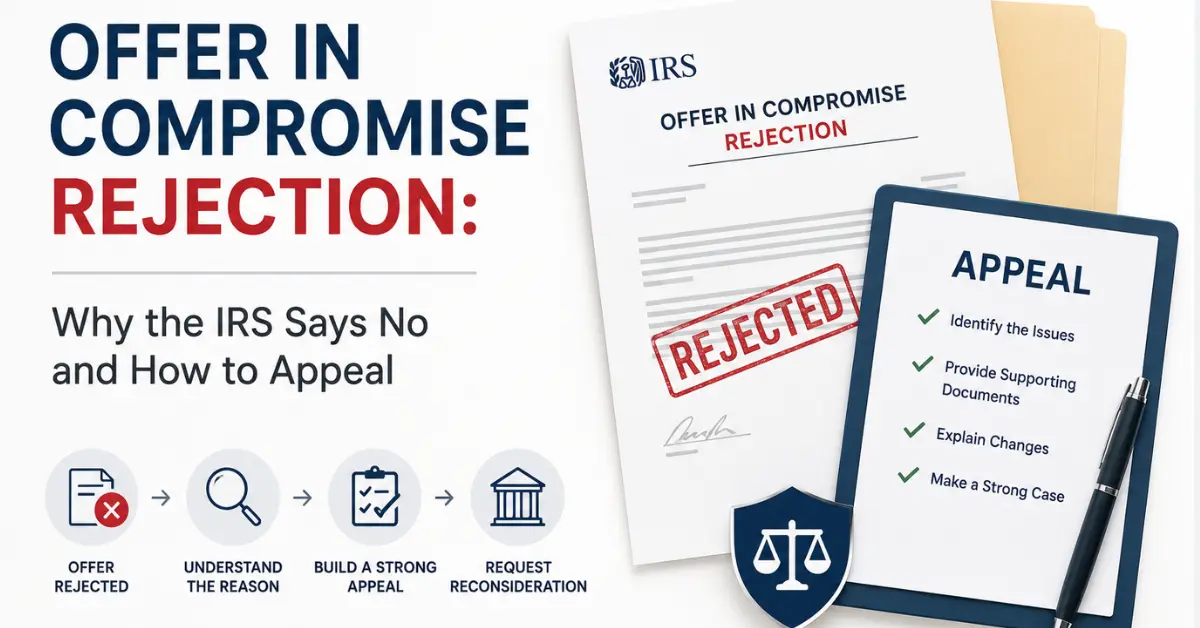
A rejection is not the final word. The IRS gives you 30 days from the date of the rejection letter to appeal to the IRS Office of Appeals. That window is firm – missing it forfeits your right to appeal this rejection.
The appeal goes to an Appeals Officer who is independent from the examiner who rejected your offer. That independence matters. Appeals Officers are specifically tasked with settling cases, and they have authority to accept offers that the initial examiner rejected. They evaluate the case on its merits, not on the prior examiner’s conclusions.
To file the appeal, you submit a written protest that includes:
- A statement that you are appealing the rejection
- A copy of the rejection letter
- The tax periods and amounts at issue
- The specific items you disagree with and why
- Any facts, law, or arguments supporting your position
- A penalty of perjury statement
The quality of this protest determines a significant part of your outcome. A protest that simply says “I disagree with the rejection” gives the Appeals Officer nothing to work with. A protest that identifies specific errors in the examiner’s RCP calculation – with documentation supporting your figures – gives the Appeals Officer a concrete basis for accepting a revised offer.
During the appeals conference, you or your representative meets with the Appeals Officer to discuss the case. This is a negotiation. The Appeals Officer has the authority to accept a modified offer amount, accept the original offer, or sustain the rejection. Coming prepared with a clear analysis of where the examiner got the numbers wrong – and what the correct figures should be – is what moves these conferences toward acceptance.
For cases involving collection action that’s already underway, there’s also the Collection Appeals Program, which operates through a different channel. The IRS Collection Appeal Form 9423 covers how that process works and when it applies.
Appeal vs. Refile vs. Pivot to an Installment Agreement
After a rejection, you have three meaningful paths forward. Choosing the right one depends on why the offer was rejected and what your financial picture actually looks like.
Appeal the rejection when the examiner made a specific, identifiable error in the RCP calculation. This is the right path when the examiner used the wrong income figure, improperly valued an asset, refused a legitimate expense, or included dissipated assets that don’t meet the legal standard for inclusion. If the rejection is based on a calculation error rather than a fundamentally strong RCP, appeal is the fastest route to resolution.
Refile a new OIC when your financial circumstances have genuinely changed since the original submission, or when the original submission had preparation errors that a new submission can correct. A new OIC starts the process fresh – it does not rely on the prior submission. If your income dropped significantly, you incurred major new expenses, or the original submission was simply prepared poorly, refiling with a stronger case can succeed where the first attempt failed. For a detailed breakdown of what the IRS is actually looking for in a successful submission, the guide to getting an offer in compromise approved covers the approval criteria in depth.
Pivot to an installment agreement when your RCP genuinely exceeds the tax liability – meaning the IRS calculation of what you can pay is accurate and your offer was legitimately too low. If the math doesn’t support an OIC, pursuing one further wastes time and money while interest continues to run. A properly structured installment agreement, potentially combined with penalty abatement, may produce a better outcome than continuing to fight an OIC that the numbers don’t support.
The honest assessment here matters. A rejection doesn’t always mean you had a bad case. But it sometimes does mean the OIC was not the right tool for your situation, and recognizing that early saves you from spending months or years on a strategy that won’t resolve the debt.
Frequently Asked Questions
What does it mean when the IRS rejects an offer in compromise?
An offer in compromise rejection means the IRS determined that your submitted offer amount falls below your Reasonable Collection Potential – the minimum amount the IRS calculates it can collect from you through standard enforcement. The rejection letter will identify the specific basis for the decision. You have 30 days from the date of the letter to appeal to the IRS Office of Appeals.
How long do I have to appeal an offer in compromise rejection?
You have 30 days from the date of the IRS rejection letter to file an appeal with the IRS Office of Appeals. This deadline is strict. Missing the 30-day window forfeits your right to appeal this particular rejection, though you retain the right to submit a new OIC if your circumstances support it.
What are the most common reasons the IRS rejects an offer in compromise?
The most common rejection reasons are: an offer amount below the calculated Reasonable Collection Potential, income figures the IRS disputes or recalculates higher, asset equity the examiner values differently than the taxpayer, dissipated assets added back into the RCP calculation, living expenses reduced to IRS standard amounts rather than actual expenses, and non-compliance issues such as unfiled returns or missing estimated tax payments.
Can I submit a new offer in compromise after a rejection?
Yes. A rejection does not permanently bar you from submitting a new OIC. You can refile at any time, and a new submission is evaluated independently of the rejected one. Refiling makes the most sense when your financial circumstances have materially changed, or when the original submission had preparation errors that a new, more carefully prepared submission can correct.
What is the IRS Office of Appeals and how does it handle OIC rejections?
The IRS Office of Appeals is an independent function within the IRS that reviews disputed IRS decisions, including OIC rejections. Appeals Officers are separate from the examiners who process OIC submissions and have authority to accept offers that the initial examiner rejected. The appeals process involves submitting a written protest within 30 days of the rejection and, typically, an in-person or telephone conference with the Appeals Officer to present your case.
A Rejection Isn’t the End – But Your Next Move Matters
An offer in compromise rejection is frustrating. It’s also, in many cases, recoverable – either through the appeals process or a stronger resubmission. The key is understanding exactly why the IRS said no, whether that reason reflects a genuine limitation on your case or a correctable error, and which path forward serves your actual interests.
What I’ve seen consistently is that taxpayers who treat a rejection as diagnostic information rather than a final verdict tend to reach better outcomes. The rejection tells you what the IRS thinks your RCP is. If that number is wrong, you have a clear target for your appeal. If it’s right, you have clarity about which resolution tool actually fits your situation.
Silver Tax Group handles OIC submissions, appeals, and the full range of IRS collection resolution strategies. If your offer in compromise was rejected – or if you’re considering filing an OIC and want to do it right the first time – contact us to review your case and map out a strategy that reflects your actual financial picture.