

If you’ve ever received a CP2501 letter from the IRS and wondered why, read on. It’s not just any letter; it’s an invitation to explore discrepancies they’ve noticed. This might sound like navigating through a maze blindfolded but don’t worry. We’ll walk through this together, shedding light on what receiving one of these notices means for you and how best to address it with effective tax debt resolution.
- CP2501 notices inform taxpayers of income discrepancies that may change tax liability.
- Review, compare, and respond to the notice by the due date, including explanations and supporting documents if disagreeing.
- Tax professionals can assist in understanding, gathering documents, and communicating with the IRS.
- Ignoring CP2501 leads to increased liability, penalties, and future relief difficulties. Respond within 60 days.
- Avoid future notices by double-checking returns, reporting income accurately, and keeping organized tax records.
Understanding IRS Notice CP2501
If you’ve received a CP2501 notice from the IRS, you must act fast to avoid getting slapped with a higher tax bill than you deserve. Stick around as we dive into what this notice is all about and the steps you should take next.
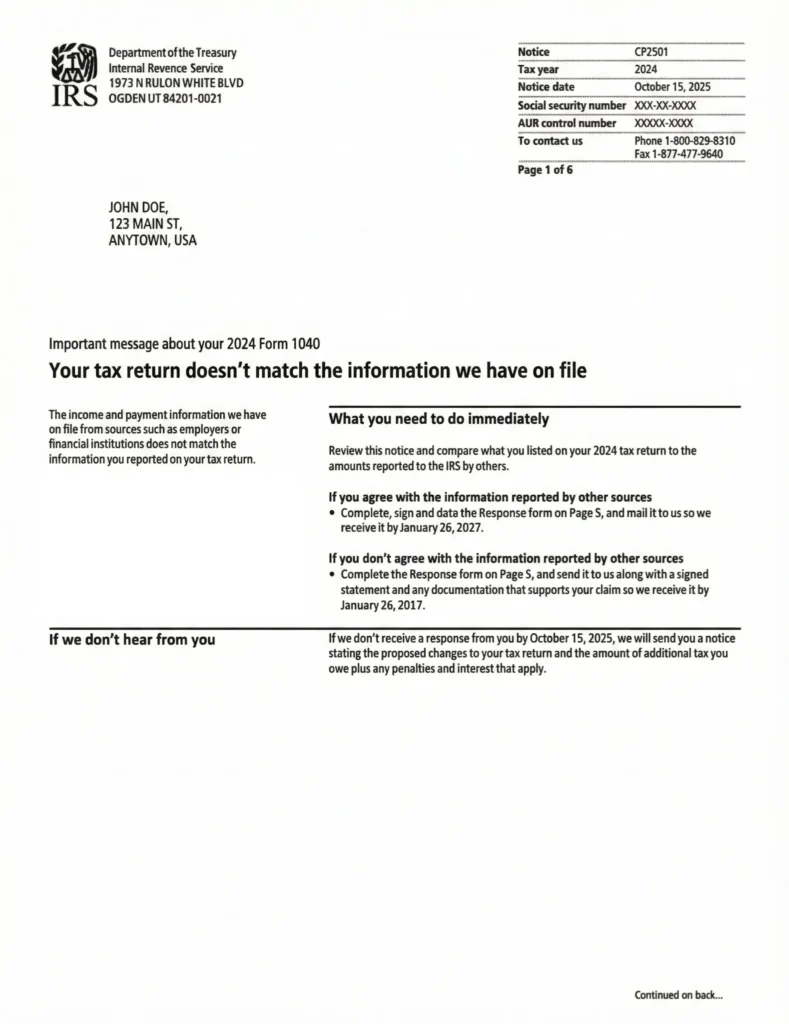
What is Notice CP2501
Why did you receive it?
The IRS found a discrepancy between your income tax return and the information reported to them by employers, banks, businesses, or other payers. This could be due to not reporting income, overstating deductions, or claiming incorrect credits.
What to Do When You Receive CP2501 (5 Steps)
Receiving a CP2501 notice means the IRS found discrepancies in your tax return. Acting quickly can prevent penalties and ensure a smooth resolution. Here’s what to do:
- Review the Notice & Compare With Your Tax Return
- Check the discrepancies flagged by the IRS-income mismatches, deductions, or missing tax forms.
- Compare the notice with your original tax return to identify errors or unreported income.
- Note the 60-day response deadline to avoid escalation.
- Gather Supporting Documents
- Collect records that support your tax return:
- W-2s, 1099s, bank statements
- Receipts & invoices for deductions
- Employer or financial institution correspondence
- Collect records that support your tax return:
- Choose How to Respond
- Agree? Sign and return the form with payment (if required).
- Disagree? Send a signed statement explaining why, along with supporting documents.
- Mail or submit your response before the deadline.
Ignoring a CP2501 can lead to penalties, increased tax liability, or further IRS action. In some cases, unresolved discrepancies may even increase the likelihood of a tax audit. Respond early to protect your finances and ensure you have the right IRS audit defense strategies in place.
Quick Guide on How to Respond to IRS Notice CP2501
Use this chart below to figure out what to do next before the 30-day deadline expires.
| If Your Situation Is... | Action Required | Documents to Include |
|---|---|---|
| You Agree The IRS information is correct. |
Sign and return the response form. Pay any tax owed by the deadline to avoid further interest. |
|
| You Disagree The IRS information is wrong. |
Write a signed statement explaining the specific reasons you disagree. Mail/fax it with the response form. |
|
| Identity Theft Income reported belongs to someone else. |
Call the financial institution listed to verify. File an Identity Theft Affidavit with your response. |
|
| You Need More Time 30 days isn't enough. |
Submit a written extension request to the address on the notice before the 30 days are up. |
|
| You Don't Respond WARNING |
The IRS will escalate to Notice CP2000. |
|
If You Agree with the CP2501
Sign and return the response form included with the notice. Both spouses must sign if you filed a joint return. Mail or fax it to the address provided on the notice. Pay any taxes owed by the deadline shown to avoid additional interest and penalties.
The IRS will process the adjustment and send you a notice explaining the changes they made to your account.
If You Disagree with the CP2501
Write a signed statement explaining why you disagree. Include specific reasons and supporting documentation. Mail or fax both the response form and your statement to the address on the notice.
Possible explanations include:
- The income was reported in error and doesn’t belong to you.
- You already reported the income (the form duplicates what’s on your return).
- The income is from a prior year.
- You received a corrected form after you filed that shows a lower amount.
- The income is from identity theft.
If You Partially Agree
You can sign the response form and include a statement about the specific items you disagree with. Return both documents with supporting evidence.
Use This "Copy-Paste" CP2501 Response Letter Template:
Subject: Response to Notice CP2501 – [Your Name] – [Social Security Number]
To the Internal Revenue Service:
I am writing in response to the CP2501 notice dated [Date on Notice] regarding tax year [Year].
I respectfully disagree with the proposed changes for the following reason(s):
[Reason 1]: Example: The income reported by [Bank Name] in the amount of $500 is actually a non-taxable reimbursement, not income. Please see the attached bank statement highlighting this deposit.
[Reason 2]: Example: The W-2 income from [Employer Name] was already reported on my return, but it was listed under “Other Income” on Line 8 instead of Line 1. Please see the attached copy of my 1040.
Enclosed you will find:
A copy of the CP2501 response page (signed).
Copies of the supporting documents mentioned above.
Please update my account records to reflect this information.
Sincerely,
[Your Signature] [Your Phone Number]
How to Mail in Your Response
Never use regular mail: Always use USPS Certified Mail with Return Receipt. This provides a green card (physical or electronic) proving someone at the IRS stamped and received your package.
Don’t send originals: Explicitly remind them to send copies of W-2s or bank statements. If the IRS loses the originals, the taxpayer is in trouble.
Faxing is faster: Mention that if a fax number is provided on the CP2501, faxing is acceptable and creates an instant transmission record.
The 30-Day Deadline Matters
The CP2501 shows a response deadline. Missing this deadline has real consequences. The IRS will proceed with a CP2000 notice that includes a proposed tax bill. You’ll lose negotiating power at that stage. Penalties and interest will continue to accumulate.
Request an extension if you need more time. Include your extension request with any response documents you’re sending.
What Happens If You Don't Respond
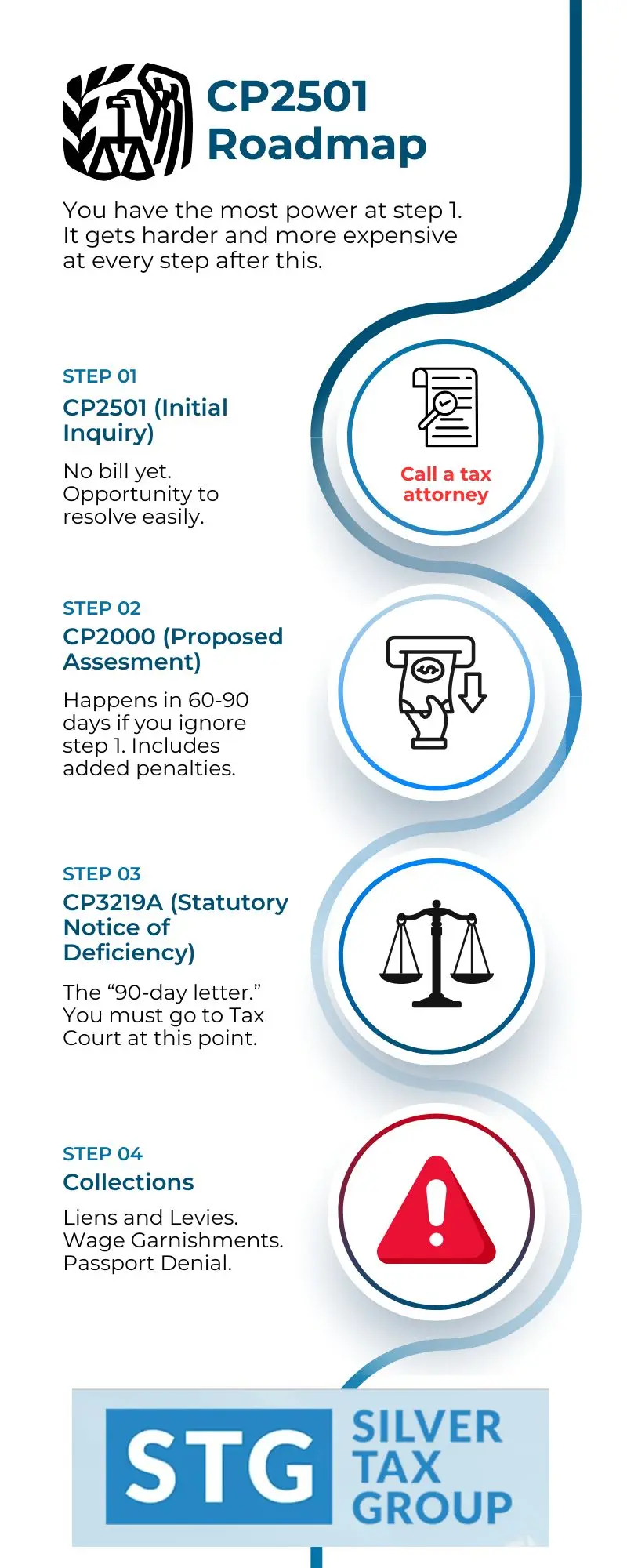
The IRS sends a CP2000 notice within 60-90 days. This notice includes a specific dollar amount for additional taxes owed, plus penalties and interest. You’ll now face a 20% accuracy-related penalty on the additional tax (40% in some cases, up to 75% if fraud is suspected). Interest compounds daily from the original return due date. Each day increases the amount you owe.
If you ignore CP2000, the IRS can take collection actions. They can issue a Notice of Federal Tax Lien. They can garnish your wages or levy your bank account. Your passport can be flagged if the debt exceeds $50,000. You may lose eligibility for payment plans or offer in compromise options. Future tax refunds will be offset to pay the debt.
Special Situation: Identity Theft
If someone used your Social Security number to obtain income, the CP2501 may show income that isn’t yours. Call the employer or financial institution listed on the notice to verify. If it’s identity theft, file Form 14039 (Identity Theft Affidavit) with the IRS along with your CP2501 response.
Special Situation: Extension Requests
If 30 days isn’t enough time to gather documentation or prepare a response, you can request an extension. Submit a written request to the IRS office shown on your notice before the 30-day deadline expires. Explain your situation: you might need time to collect documents, coordinate with a tax professional, or address other circumstances.
The IRS won’t approve every extension request, but they do approve them when you have a real reason. Don’t wait until day 29 to ask. Submit your request early so there’s time for the IRS to process it and send you a new deadline in writing.
Expert Tip: The Penalty Abatement Secret
Even if you do owe the money and made a mistake, you might not have to pay the penalty. If you have a clean tax history for the past three years, you can request ‘First-Time Abatement‘ for failure-to-pay penalties. You usually have to request this after the tax is assessed, but knowing it is an option reduces anxiety now. This is something we can help with.
How We Handle CP2501 Notices at Silver Tax Group
We gather your documents and compare them against the IRS notice. We identify which items are correct, which need explanation, and which can be disputed. We prepare your response with supporting documentation. We handle communication with the IRS directly so you don’t have to navigate phone holds and recorded lines. We meet the 30-day deadline to protect your options.
If the IRS sends a CP2000 after your response, we continue representation through that process. Our tax attorneys and CPAs work with clients across the U.S. who have received CP2501 notices. We know which explanations the IRS accepts and which ones require additional documentation.
Benefits of Hiring a Tax Professional
A tax attorney can:
- Interpret the notice and identify potential errors or misunderstandings.
- Gather and organize supporting documents to strengthen your response.
- Communicate with the IRS on your behalf, reducing stress and the risk of miscommunication.
- Negotiate payment plans or dispute discrepancies if needed.
Having an expert handle your response can prevent unnecessary penalties, speed up the resolution process, and ensure you don’t overpay in taxes.
Choosing the Right Tax Resolution Service
Not all tax resolution companies are created equal. Here’s what to look for:
- Licensed professionals – Work with CPAs, enrolled agents, or tax attorneys who specialize in IRS disputes.
- Proven experience – Check qualifications, customer reviews, and case success rates.
- Transparent pricing – Avoid firms that demand large upfront fees or make unrealistic guarantees.
- Clear communication – Ensure they have a structured process for handling cases and keeping you informed.
Taking the right approach from the start can mean the difference between a simple correction and costly IRS penalties. If you’re unsure how to proceed, seeking professional guidance is a smart move.
Common Misconceptions About CP2501 Notices
Many taxpayers panic when they receive a CP2501 notice, assuming it’s a serious legal issue or an audit. However, several misconceptions surround this notice, leading to unnecessary stress and confusion. Let’s clear them up:
“A CP2501 Notice Means I’m Being Audited” – False
Reality: A CP2501 notice is not an audit. The IRS is simply notifying you of a discrepancy in reported income and asking for clarification. While failing to respond could increase the chances of further IRS scrutiny, the notice itself is not part of a formal IRS audit process. However, understanding the different types of IRS audits can help you prepare if your case escalates.
“If I Ignore It, The IRS Will Forget About It” – False
Reality: Ignoring a CP2501 notice can lead to serious consequences. If you don’t respond within 60 days, the IRS may assume their proposed changes are correct and issue a CP2000 notice, formally adjusting your tax return. This could result in higher tax liability, penalties, and interest charges.
“The IRS Is Always Right” – False
Reality: The IRS processes millions of tax returns, and mistakes happen. Employers or financial institutions may have reported incorrect information to the IRS, leading to a discrepancy. If you believe the IRS is wrong, you have the right to dispute the notice with proper documentation.
“Responding Without Documentation Is Fine” – False
Reality: If you disagree with the IRS’s findings, simply stating your position isn’t enough. You need to provide supporting documents-such as W-2s, 1099s, or bank statements-to validate your claim. Without evidence, the IRS is unlikely to accept your dispute.
“A CP2501 Notice Automatically Means I Owe More Taxes” – False
Reality: While the IRS is flagging a discrepancy, the outcome is not predetermined. Your tax liability may increase, decrease, or remain the same depending on the accuracy of your original return. Reviewing your records and responding appropriately ensures the IRS has the correct information.
Understanding these common misconceptions can prevent unnecessary worry. The best approach is to review the notice carefully, gather evidence, and respond within the deadline to avoid complications.
Tips for Avoiding CP2501 in the Future
You can avoid future problems by double-checking your return before filing, reporting all income accurately, and keeping good records. Consider filing your taxes electronically as it can help you avoid mistakes and find credits and deductions you may qualify for.
Double-check your return before filing
Before submitting your tax return, carefully review all the information for accuracy. Double-check your income figures match your W-2s, 1099s, and other tax documents. Make sure you haven’t omitted any income or overstated any deductions or credits.
Report all income accurately
Be sure to report all your taxable income from various sources on your return, including wages, self-employment, interest, dividends, capital gains, rental income, and retirement distributions. Reference all your tax documents when preparing your return to avoid underreporting income.
Keep good records
Maintain organized records of all your tax documents, receipts, and financial statements each year. Keeping your records in tip-top shape not only smooths out the process of filing an accurate tax return but also has your back if you ever need to show proof for any claims you make on that return. Keep your records for at least 3 years from the tax filing deadline.
Take Control of Your CP2501 Notice
Dealing with a CP2501 notice might feel overwhelming, but understanding its purpose and responding promptly can make all the difference. Whether it’s an income discrepancy, a reporting error, or missing documentation, the IRS isn’t accusing you of wrongdoing-they’re simply asking for clarification.
The most important thing to remember is not to ignore the notice. Failing to respond can result in increased tax liability, penalties, and further IRS action. By reviewing your records, gathering supporting documentation, and responding appropriately, you can resolve the issue efficiently.
Being proactive is key. Whether you handle it yourself or seek professional guidance, the sooner you take action, the smoother the resolution process will be.
Get Professional Tax Help Today
If you’re uncertain about how to respond, need assistance gathering documentation, or want expert representation, working with a trusted tax professional can make the process much easier.
At Silver Tax Group, our experienced tax attorneys and enrolled agents specialize in handling IRS notices, tax discrepancies, and dispute resolution. We ensure that your response is accurate, well-documented, and strategically positioned to minimize penalties and protect your financial standing.
Take action today-contact Silver Tax Group or schedule a free consultation to resolve your CP2501 notice with confidence.
Frequently Asked Questions About IRS CP2501 Notices
What is a CP2501 notice, and why did I receive it?
A CP2501 notice is sent by the IRS when the income or payment information they received from third parties (such as employers, banks, or businesses) does not match what you reported on your tax return. This discrepancy doesn’t necessarily mean you owe more taxes, but it does require a response to clarify or correct the information.
What happens if I ignore a CP2501 notice?
Ignoring a CP2501 notice can lead to increased tax liability, penalties, and further IRS action. After 60 days, the IRS may assume their proposed adjustments are correct and issue a CP2000 notice, which can result in additional taxes owed, interest, and even a higher risk of an audit.
How should I respond if I agree or disagree with the notice?
- If you agree, sign and return the response form along with any payment, if required.
- If you partially agree or disagree, provide a signed statement explaining why, along with supporting documents like W-2s, 1099s, or bank statements.
- Ensure your response is sent before the deadline to avoid penalties.
What supporting documents should I include when responding to CP2501?
If you disagree with the notice, gather documents that support your tax return, such as:
- W-2s, 1099s, and other income statements
- Receipts for claimed deductions
- Bank statements or employer correspondence
- Any prior IRS communications related to the discrepancy
Should I get professional help to handle a CP2501 notice?
While some taxpayers can handle a CP2501 response on their own, seeking professional assistance is recommended if:
- You don’t understand the discrepancy or need help reviewing your tax records.
- You’re disputing the notice and need a strong case with supporting evidence.
- You want to minimize penalties or set up a payment plan if additional taxes are owed.
- You want a tax professional to communicate with the IRS on your behalf.